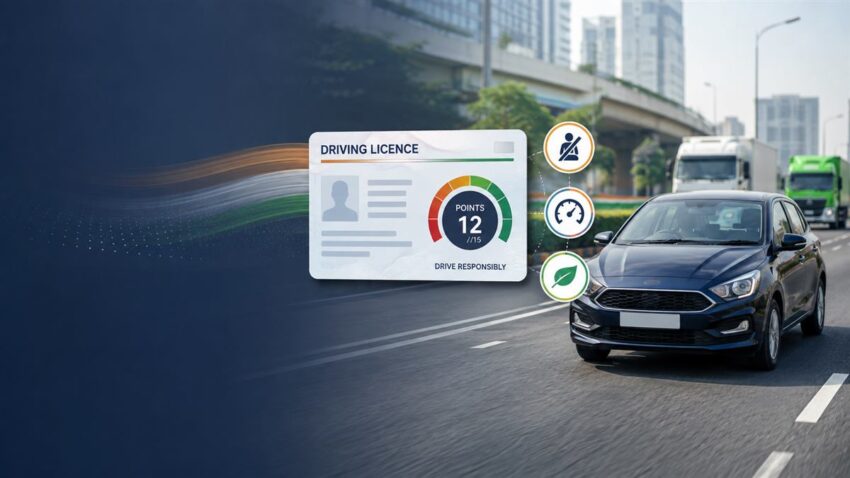
India’s proposed driving licence points system could change how repeat traffic offences are tracked and how licensing authorities respond to unsafe driving. The idea, discussed by the Ministry of Road Transport and Highways (MoRTH) with state transport ministers in January 2026, would attach penalty points to a driver’s record in addition to existing fines or other punishment.
Important: this is a proposed reform, not a nationwide rule currently in force. Drivers should continue to follow the Motor Vehicles Act, applicable state rules and official notifications. Exact point values, thresholds and implementation dates will only be clear after the required legal and regulatory process.
What is the proposed driving licence points system?
Under a points-based model, specified traffic violations would add penalty points to the driving licence record. Less serious offences could attract fewer points, while dangerous conduct could attract more. A central digital record could help authorities identify repeat offenders across multiple incidents instead of treating every challan in isolation.
At the January 2026 annual meeting of transport ministers, the government listed an “introduction of a points-based system for tracking traffic violations” among proposed Motor Vehicle reforms. The discussion also covered stronger e-enforcement, integration of transport databases and improved driving-licence data quality.
Could repeated violations suspend or cancel a licence?
That is the main enforcement logic behind a demerit-points system. If a driver crosses a prescribed threshold within a defined period, the licensing authority could be empowered to suspend or revoke the licence, require refresher training, or impose another corrective measure. However, the final thresholds, expiry period for points, appeal process and treatment of different offences have not yet been officially notified as a nationwide framework.
The current Motor Vehicles Act already permits licence disqualification or revocation in specified circumstances. A points framework would make repeat-offence tracking more systematic, but any new consequences must come through duly notified provisions.
What about benefits for good drivers?
A clean driving record may eventually support incentives such as safer-driver recognition or risk-based motor-insurance benefits. Such benefits are possible policy outcomes, but they should not be treated as a confirmed entitlement at this stage. Any insurance discount would depend on the final rules, availability of reliable driving-history data and the products approved or offered by insurers under regulatory requirements.
PARIVARTAN vehicle-renewal scheme: the confirmed details
Separate from the proposed licence-points reform, the government has launched the PARIVARTAN scheme—Programme for Accelerated Renewal and Incentivization of Vehicle Assets for Reducing Transport Air Pollution and Network Emissions. It is designed to replace more than two lakh older trucks and buses registered in Delhi-NCR with BS-VI-or-stricter vehicles or electric alternatives.
The scheme has a total financial outlay of ₹9,585 crore, including ₹5,041 crore in Central Government budgetary support. It applies to eligible BS-IV or earlier trucks and buses in Delhi and NCR districts of Haryana, Rajasthan and Uttar Pradesh. It is not a general nationwide cash incentive for every private car owner.
Key PARIVARTAN incentives for eligible beneficiaries
- 5% interest savings on eligible vehicle loans for five years;
- 10-year road-tax waiver and full registration-fee waiver in participating states;
- at least 8% discount on the ex-showroom price from participating manufacturers;
- monthly fuel vouchers for eligible BS-VI diesel or CNG vehicles, or a one-time incentive for eligible electric vehicles.
For BS-III or older vehicles, scrapping through a Registered Vehicle Scrapping Facility is mandatory. Eligible BS-IV vehicles may be scrapped or moved outside NCR under the scheme conditions. By 27 August 2026, more than 1,300 beneficiaries had registered, with 42 banks and NBFCs and 15 vehicle manufacturers onboarded.
Why the proposal matters for road safety
India’s road-safety challenge is not only about collecting fines; it is about changing repeated risky behaviour. A transparent points system could create escalating consequences for drivers who repeatedly speed, jump signals, drive dangerously or commit other serious offences. Digital integration with e-Challan and licence databases could also improve consistency.
For the system to work fairly, the final framework should provide accurate records, timely notice of points, a clear appeal route, protection against duplicate entries and a practical way for drivers to check their status online. Awareness campaigns and refresher training would be just as important as penalties.
What drivers should do now
- Do not rely on viral “new rule” messages. Check official MoRTH, PIB, state transport department and Parivahan updates.
- Pay and contest challans through official channels. Keep your licence, registration, insurance and pollution certificate current.
- Use DigiLocker or mParivahan. Legally recognised electronic transport documents can make roadside verification easier.
- Build a clean record today. Speed limits, helmets, seat belts, lane discipline and sober driving remain essential regardless of when a points system arrives.
Bottom line
India’s proposed driving licence points system signals a shift toward data-led enforcement and stronger consequences for repeat offenders. Suspension or cancellation may form part of the final model, while benefits for consistently safe drivers remain a possibility rather than a confirmed rule. Meanwhile, PARIVARTAN is already an approved, targeted Delhi-NCR commercial-vehicle renewal scheme with ₹5,041 crore in Central support within a ₹9,585 crore total outlay.
This article is for general information and reflects official material available on 3 September 2026. Rules may change; always consult the latest government notification.
Official sources
- MoRTH annual meeting: proposed points-based system
- Cabinet approval and scope of PARIVARTAN
- PARIVARTAN implementation update