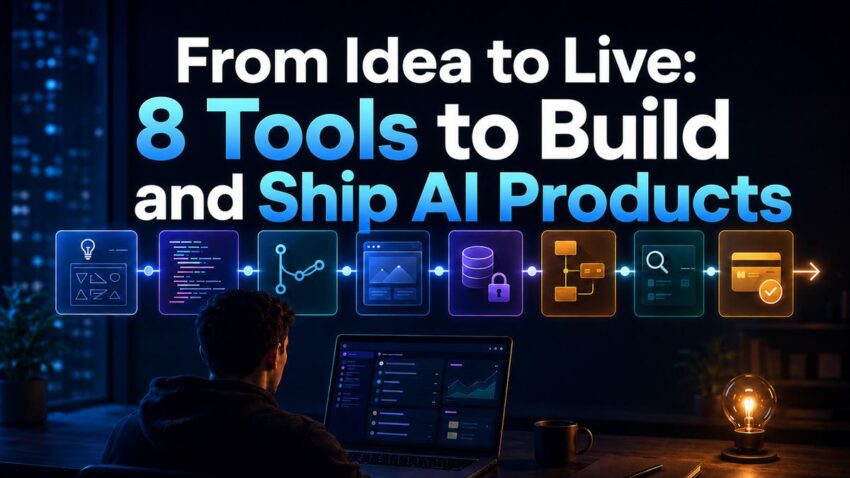
The best tools to build AI products are the ones that move an idea into users’ hands quickly. My current agency stack is simple: Claude to shape the build, Claude Code to write it, GitHub to protect the work, Vercel to ship the frontend, Supabase for data and identity, n8n for automation, Perplexity for research, and Stripe to collect payments.
A few years ago, that pipeline often crossed product strategy, engineering, DevOps, data, automation, research and billing teams. Today, one capable builder can run most of it from a laptop. That does not make the work effortless—it compresses the distance between deciding and doing.
The eight-tool idea-to-launch stack
Each tool has one primary job. Keeping those boundaries clear reduces complexity and makes the stack easier to replace later.
1. Claude: think through the build
Before code, use Claude as a product-thinking partner. Turn a loose idea into a user story, define the smallest useful version, list edge cases and clarify what success looks like. Ask for assumptions, failure modes and a staged implementation plan.
The useful output is not a giant specification. It is a short decision document: who the product serves, what problem it solves, the first workflow to ship, the data it needs and what can wait. Better questions here prevent expensive code later.
2. Claude Code: write and iterate
Claude Code moves the plan into a real codebase. It can inspect a repository, edit files, run commands and tests, and help trace errors. Give it a bounded task, relevant context and an objective way to verify success.
Do not outsource judgment. Review diffs, test critical paths and keep secrets out of prompts and source files. An AI coding agent accelerates implementation; it does not remove your responsibility for security, architecture or product quality.
3. GitHub: make every change recoverable
GitHub is the system of record. A repository stores the code, files and revision history, while branches and pull requests make changes easier to review. Even a solo builder benefits: commits create checkpoints, issues preserve decisions and automated checks catch regressions.
Connect deployment to the repository early. The project should be reproducible from source, not dependent on files that exist only on one laptop.
4. Vercel: deploy the frontend
Vercel is a fast path from a Git repository to a live web application. It supports common frontend frameworks, creates preview deployments and provides production infrastructure without requiring a solo founder to operate servers on day one.
Use preview URLs to test the actual product before merging. Configure environment variables separately for development, preview and production, and verify analytics, error handling and custom-domain settings before launch.
5. Supabase: authentication and database
Supabase provides a Postgres database plus authentication, storage, realtime features and APIs. Auth supports common sign-in methods and integrates with Row Level Security (RLS), which can restrict records based on the signed-in user.
The speed is excellent, but defaults are not a security strategy. Enable RLS on exposed tables, grant the least privilege required and never place service-role or secret keys in frontend code. Model the data around user actions, not around whatever is quickest to generate.
6. n8n: connect the workflows
n8n handles the glue: webhooks, scheduled jobs, notifications, enrichment, CRM updates and multi-step back-office processes. It is ideal when a workflow crosses several services and does not belong in the main request-response path of the app.
Design automations for failure. Add retries, idempotency, logging and alerts. A workflow that succeeds in a demo but duplicates charges or loses leads during an outage is not production-ready.
7. Perplexity: accelerate research
Perplexity is useful for quick market scans, competitor discovery, terminology and source gathering. Treat it as a research starting point, not an authority. Open the original sources, compare dates and verify any claim that affects product, legal, medical, security or pricing decisions.
Research should end in action: a sharper problem statement, a better onboarding flow, a rejected assumption or a measurable experiment.
8. Stripe: collect payments
Stripe turns a working product into a business. Stripe Checkout offers a low-code hosted or embedded payment page for one-time purchases and subscriptions. Start with the simplest payment flow that matches the offer.
Do not unlock paid access only from a browser redirect. Confirm payment through server-side events such as webhooks, make fulfilment idempotent, test refunds and failed renewals, and understand the tax and compliance obligations that apply to your business.
How the pipeline works from idea to live
- Define: use Claude to reduce the idea to one painful problem and one valuable workflow.
- Research: use Perplexity to find the market language, alternatives and primary sources.
- Build: use Claude Code in a local repository with small, testable tasks.
- Save: push clean commits to GitHub and use branches for meaningful changes.
- Power: add Supabase tables, authentication and carefully tested RLS policies.
- Automate: move cross-service and asynchronous work into n8n workflows.
- Deploy: connect GitHub to Vercel, inspect a preview and promote the tested version.
- Monetize: add Stripe Checkout and verify fulfilment with signed webhooks.
The stack is not the advantage
Almost any modern version of these categories can work. Swap Claude for another capable model, Vercel for another hosting platform, Supabase for another managed backend, n8n for another workflow engine, or Stripe for a payment provider available in your market.
People burn weeks comparing stacks because tool selection feels safer than exposing a product to users. But the edge is rarely a particular logo. The edge is understanding a real problem, choosing a narrow promise, shipping a reliable solution and learning faster than everyone still researching frameworks.
The tools are leverage. What you ship with them is the advantage.
A practical solo-builder checklist
- Can a new user understand the promise in ten seconds?
- Does the core workflow solve one complete job?
- Are secrets stored in environment variables rather than code?
- Are authentication and database permissions tested with real user roles?
- Can automated jobs retry safely without creating duplicates?
- Are errors visible through logs or alerts?
- Can you roll back to a known-good commit and deployment?
- Does payment fulfilment rely on verified server-side events?
- Have you spoken to or observed actual target users?
Final take
This is the stack I reach for when running agency projects because it covers the full loop: think, research, code, version, deploy, store, automate and charge. Nothing here is sacred. Use the tools you already understand, replace the pieces that do not fit, and avoid architecture built for traffic you do not have.
The modern builder advantage is not owning eight subscriptions. It is being able to move from an informed idea to a trustworthy live product while the feedback is still fresh.
Official documentation
- Anthropic Claude Code
- GitHub repositories
- Vercel platform
- Supabase documentation
- n8n documentation
- Perplexity documentation
- Stripe Checkout