
Explore how water usage in AI data centers, why cooling demand is increasing, and how liquid cooling can support more efficient and sustainable AI infrastructure. Artificial intelligence is changing the way businesses, schools, hospitals, governments, and individuals use technology. From chatbots and image generation to automation, analytics, cybersecurity, and cloud applications, AI depends on powerful computing systems. These systems run inside large data centers filled with servers, processors, storage devices, networking equipment, and high-performance chips. While users experience AI as a digital service, behind the scenes it requires electricity, hardware, cooling, and in many cases, water.
One of the most important discussions around AI infrastructure today is water usage. Data centers produce a large amount of heat because servers operate continuously. AI workloads are especially demanding because they use powerful chips such as GPUs and AI accelerators. These chips process huge amounts of data at high speed, which increases heat generation. If this heat is not managed properly, equipment performance can fall, servers can shut down, and hardware life can be reduced.
Traditionally, many data centers have used air cooling systems. In a basic setup, cool air is pushed into server rooms while hot air is removed. Larger facilities may also use chillers, cooling towers, or evaporative cooling systems. In evaporative cooling, water helps remove heat from the facility. This can be effective, but it also means the data center may consume significant amounts of water, especially in hot regions or during periods of high computing demand.
Water use in AI data centers is not only about the water used inside the building. There is also indirect water usage connected to electricity generation. If the power used by a data center comes from sources that require water for cooling or processing, the overall water footprint becomes higher. This means AI sustainability cannot be judged only by server efficiency. It must also consider the source of electricity, local climate, cooling design, and water availability in the surrounding area.
The location of a data center plays a major role. A facility built in a cool climate may need less active cooling than one built in a desert or humid region. Similarly, a data center in an area with strong water resources may create less pressure than one operating in a water-stressed location. As AI demand grows, communities are becoming more concerned about whether large technology facilities will compete with homes, agriculture, and industries for freshwater.
To measure water efficiency, the industry often looks at Water Usage Effectiveness, commonly known as WUE. This metric compares the amount of water consumed with the energy used by IT equipment. A lower WUE generally means better water efficiency. However, this number should be understood carefully. A data center may have a good WUE during certain seasons and a higher water impact during hot months. That is why transparent reporting is important.
One advanced method that can reduce cooling pressure is liquid cooling. Instead of using only air to cool the room, liquid cooling moves heat away from the hottest components more directly. Since liquid can carry heat more efficiently than air, it can cool powerful AI chips faster and with less energy in many cases.
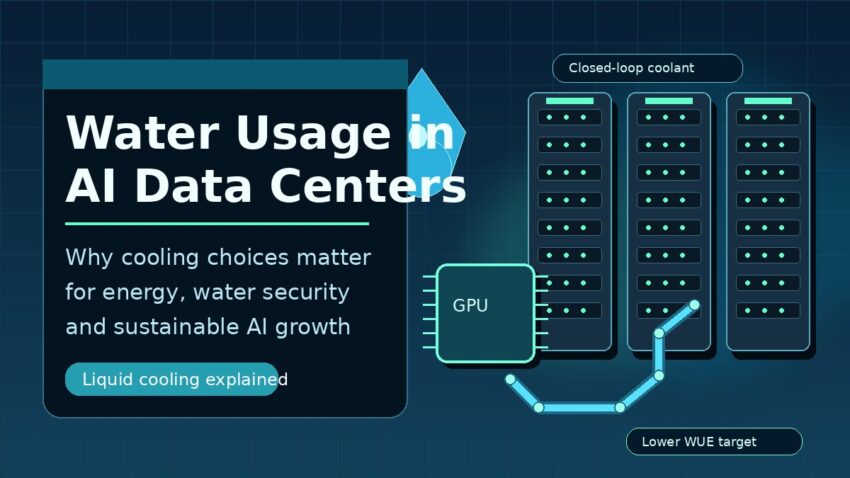
A common type of liquid cooling is direct-to-chip cooling. In this system, a special cold plate is attached to the processor, GPU, or AI accelerator. Coolant flows through the cold plate, absorbs heat from the chip, and carries it away through a closed loop. The heat can then be transferred to another system for removal or reuse. This method is useful for high-density AI racks where air cooling alone may not be enough.
Another advanced option is immersion cooling. In immersion cooling, servers or components are placed inside a special non-conductive liquid. The liquid absorbs heat directly from the hardware. This approach can support very dense computing environments, but it requires proper design, compatible equipment, and trained maintenance teams.
Liquid cooling does not automatically eliminate all water usage, but it can reduce dependence on traditional air and evaporative cooling systems. Some designs use closed-loop coolant, meaning the liquid circulates again and again instead of being consumed continuously. When combined with dry coolers, recycled water, renewable energy, and efficient chips, liquid cooling can become an important part of sustainable AI infrastructure.
The future of AI data centers will depend on balancing performance with responsibility. Companies need faster computing power, but they also need to manage electricity use, water impact, carbon emissions, and local environmental concerns. Better cooling systems, smarter facility design, and transparent water reporting will become essential.
AI will continue to grow, but the infrastructure behind it must evolve. Water-efficient cooling methods such as direct-to-chip liquid cooling and immersion cooling can help data centers support advanced AI workloads while reducing pressure on natural resources. Sustainable AI is not only about better software. It also depends on better buildings, better cooling, better energy choices, and better planning.
Author




Sijo Thomas is a web developer, SEO-focused content creator and digital tools builder at Smart Web Solutions. He creates practical web tools, technology guides and helpful online resources covering web development, WordPress, SEO, artificial intelligence and everyday digital solutions. His work focuses on making technology easier to understand and providing useful, user-friendly solutions for individuals and businesses.
LinkedIn:https://www.linkedin.com/in/sijo-thomas-it-seo-and-dm/